
Lipari
Lipari is the largest and most populated of the Aeolian Islands, but above all it is their natural hinge. Its central, almost barycentric position within the archipelago has always made it a reference point for those arriving and departing. It is from here that movements are organized, and here that one returns in the evening after a day spent between sea and wind.
From Lipari, it is easy to reach all the other islands: hydrofoils, daily sea excursions, and rental boats—both with or without skipper—allow the archipelago to be explored at different rhythms, while keeping Lipari as a stable, welcoming, and familiar base. Its size inevitably makes it the busiest island, especially during the summer months. In August in particular, it can become more lively, at times even hectic. And yet, even then, Lipari does not lose its charm: it is enough to move just beyond the most frequented streets to rediscover its authentic beauty.
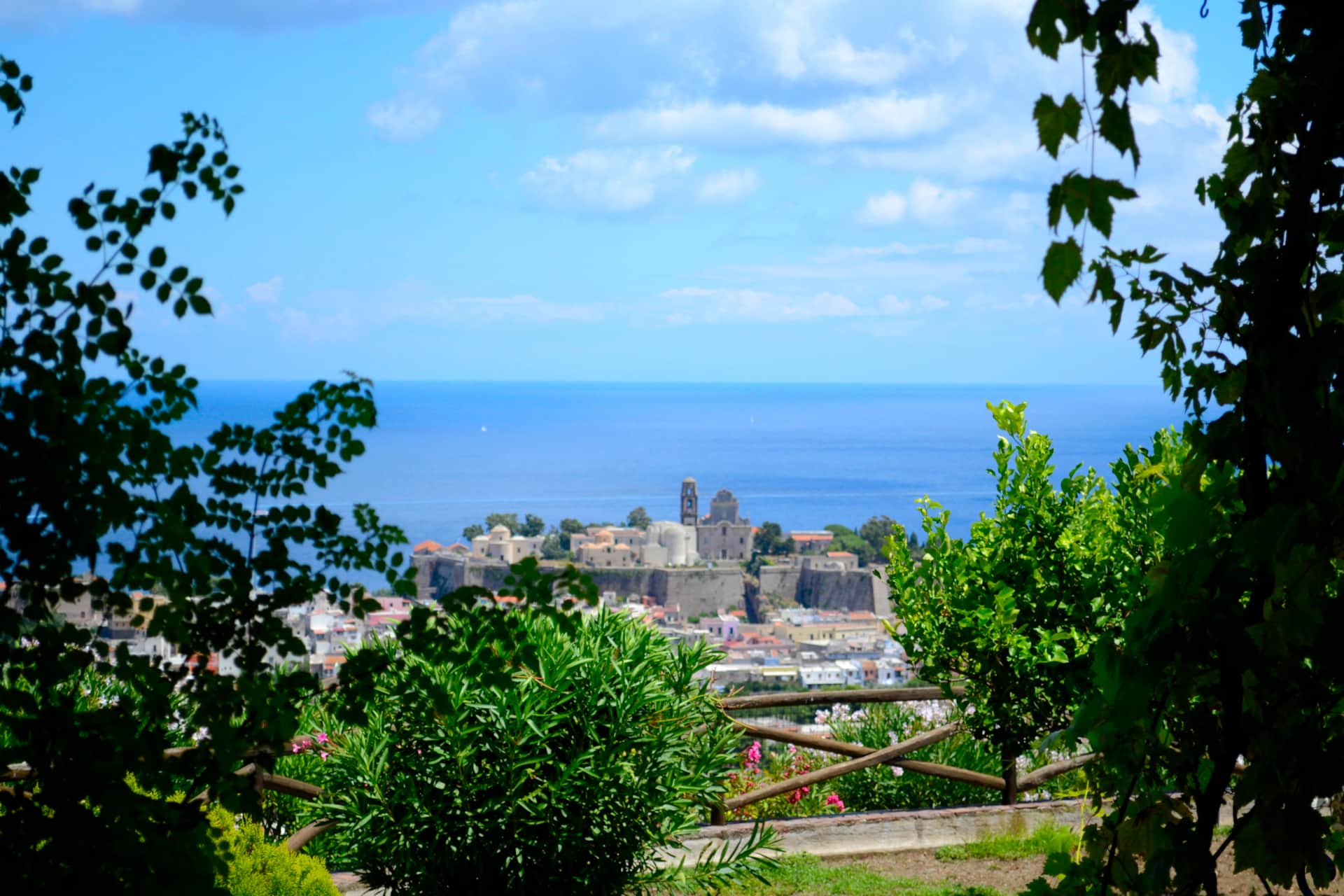
Upon arrival by sea, the Castle appears like an ancient sentinel, visible from afar, imposing yet reassuring. It is the first sign of an island that does not reveal itself immediately, that carefully guards some of its secrets and unveils them only to those who choose to explore it with curiosity and slowness. Lipari is like this: a succession of discoveries, unexpected views, architectural and natural wonders that unfold effortlessly. Cloisters, churches, beaches, generous cuisine, and a lively yet never overwhelming nightlife—here, there is truly an abundance of choice.
As early as Greek times, the island was known as Lipara, a name meaning “bright” and “fertile.” Fishermen, drawn to its rich and desirable coasts, could not help but approach it, following the sea in search of fortune. Only more rarely did they venture inland to gather the fruits the island had to offer. An ancient relationship, made of respect and necessity, still perceptible today in the deep bond between Lipari and the sea that surrounds it.
The Castle and the Cathedral of S. Bartolomeo Apostolo
There is a place that dominates the historic center of Lipari and that, paradoxically, can sometimes go unnoticed by those who experience it every day. The Castle is a silent, imposing presence, almost taken for granted by the island’s inhabitants, yet it is the guardian of a thousand-year-old history that likely began around 4000 BC.
Over the centuries, this promontory has accumulated layers of life and civilization: the Neolithic period, the Bronze Age, and the age of metals. Archaeological studies conducted over many years have uncovered a sequence of layers exceeding ten meters in depth, revealing a complex story of dominations, transformations, and continuity.
The structure we see today dates back to the 16th century, when Charles V ordered its construction with the aim of protecting the town and making the citadel impregnable. The promontory’s position, with heights reaching fifty meters above the sea, reinforces its strategic role. Crossing the Gothic-style entrance, one steps into a space where different eras overlap: Roman fortifications, medieval structures, and Renaissance elements coexist in a remarkable balance.
The large gate, topped with the Bourbon coat of arms, leads into an area rich in sacred buildings. Among these, the Church of Santa Caterina and the Church of the Addolorata stand out, the latter also dating back to the 16th century. Its interiors preserve finely decorated altars, Baroque stuccoes, and a painting depicting the Crucifixion.
Quattrocchi
There is a spot on the island where you only need to stop for a moment to understand, without any explanation, what the word “panorama” truly means.
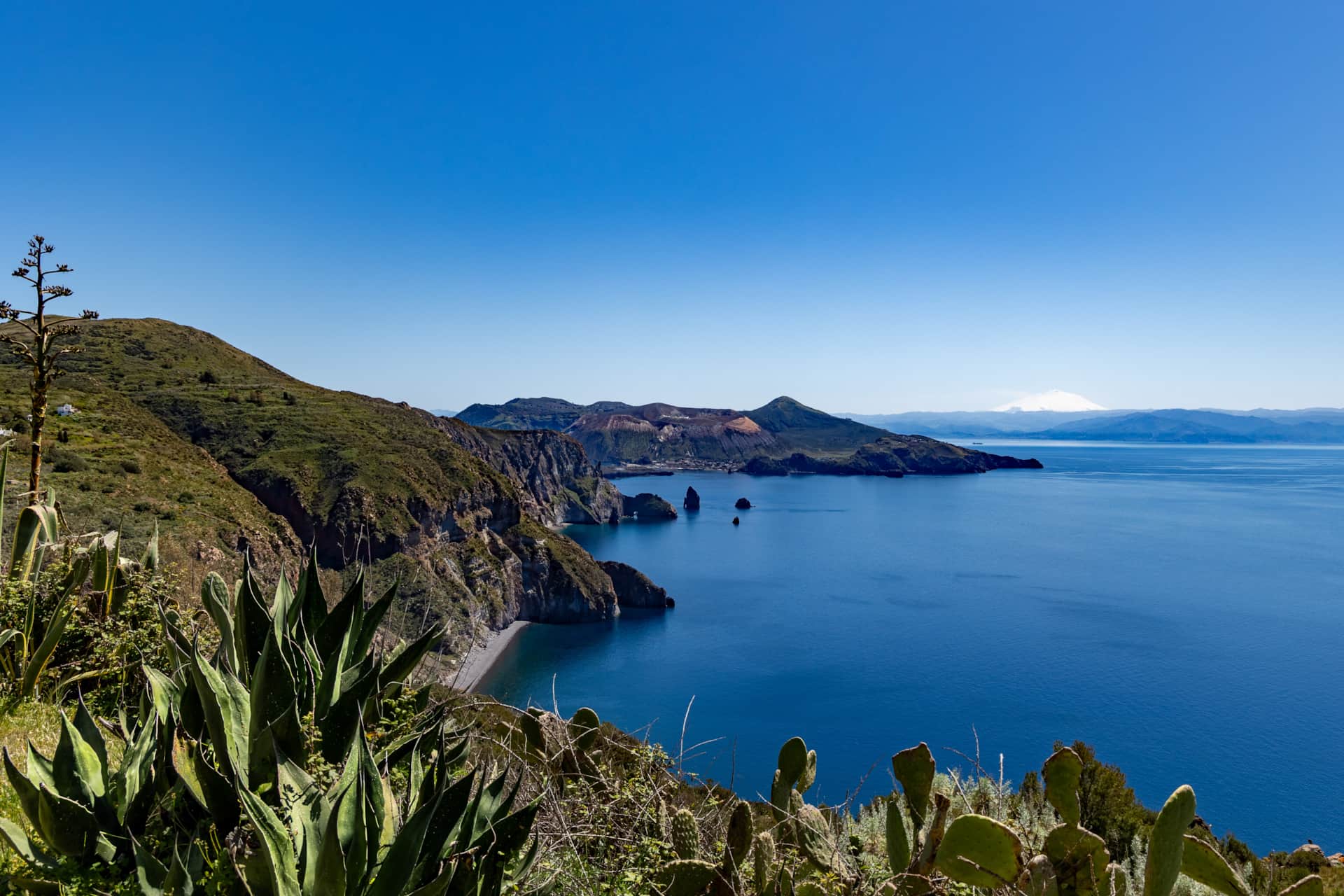
Quattrocchi is a small viewpoint along the road that leads from the center of Lipari toward Pianoconte, about four kilometers from the heart of the island. It is a simple, almost unexpected place, yet it offers one of the widest and most spectacular views of the Aeolian Islands.
From here, the gaze extends all the way to the northern coast of Sicily. In the foreground, the Faraglioni rocks emerge, while the island of Vulcano stands out with its unmistakable silhouette. It is a view that invites you to stop, to breathe, to take a photo—yes, even that perfect Instagram shot—but above all, to take the time to simply observe, unhurriedly, the magnificence of the landscape.
The Archaeological Museum
In the heart of Lipari’s Castle lies one of the most important archaeological museums in the Mediterranean, founded in 1954 thanks to the extraordinary discoveries made on the island and throughout the Aeolian archipelago.
Its rooms preserve meticulously catalogued artifacts, the result of excavations that began in the 1940s and continue to this day. It is a living museum, constantly evolving, shaped over time by the passionate work of those who preserve its identity.
The exhibition route guides visitors from prehistory to the classical age, with thematic sections that narrate the history of the archipelago. Particularly fascinating are the artifacts linked to the cult of the god Aeolus: votive objects discovered in an ancient well and dating back to the 5th century AD, a testament to the deep connection between the inhabitants and the forces of nature.
Equally remarkable are the rooms dedicated to the classical period, featuring large funerary vases, burial goods, Byzantine artifacts, jewelry, and Greek coins. The journey concludes with a section on volcanology, which helps explain the powerful geomorphological origins of the Aeolian Islands.
Osservatorio
On the heights of Monte Guardia stands what locals simply call “the Observatory.” From here, the view embraces Vulcano, Filicudi, Alicudi, and, farther away, the entire outline of Sicily.
This place is not only one of the island’s most beloved panoramic viewpoints, but also a key scientific station for monitoring volcanic activity at Vulcano and Stromboli. Today it is managed by the INGV of Catania and continues to quietly observe the deep breath of the Earth.
Norman Cloister
Inside the walls of the Castle lies a place of rare elegance: the Norman Cloister. Dating back to the 12th century, it was part of an ancient Benedictine monastery—the first built in Sicily—destroyed in 1544 during the Turkish invasion.
Forgotten for centuries, later turned into a cemetery and eventually buried behind a wall after an earthquake, the cloister was rediscovered and brought back to light in the late 1970s. Today, visitors can admire capitals carved with mythological animals and doves, traces of ancient flooring, and remains of frescoes.
The columns, finely fluted and sourced from ancient Roman houses, surround what was once likely a lush garden. A place of silence and beauty, where history still seems to whisper.
Church San Giuseppe
Overlooking the sea in the heart of Marina Corta, the Church of San Giuseppe immediately stands out for its striking location. Legend has it that a crypt containing the relics of Saint Bartholomew once stood here, upon which the church was later built.
The interior is intimate yet rich in detail: sculptures and frescoes by local 17th-century artists, along with a depiction of the Lourdes grotto, create an atmosphere that is both personal and deeply evocative. A small gem set between the sea and the village.
Cave di Caolino
Tra le sorprese che Lipari regala a chi decide di esplorarla con calma ci sono le Cave di Caolino, sulla costa nord-occidentale dell’isola. Un’antica miniera oggi in disuso, raggiungibile sia in auto che a piedi, che racconta un passato legato all’estrazione di un minerale prezioso, utilizzato soprattutto nell’arte ceramica.
Dal punto d’ingresso delle cave si apre un panorama ampio e selvaggio. Un sentiero si snoda tra la vegetazione, dove orchidee e fiordalisi eoliani colorano il paesaggio. Intorno, le pareti della cava esplodono in una tavolozza di colori: gialli intensi, rosa delicati, rossi e aranci accesi.
Le fumarole, ancora attive, ricordano che qui la terra è viva. Un luogo potente, quasi primordiale, dove la natura vulcanica di Lipari si manifesta in tutta la sua forza.